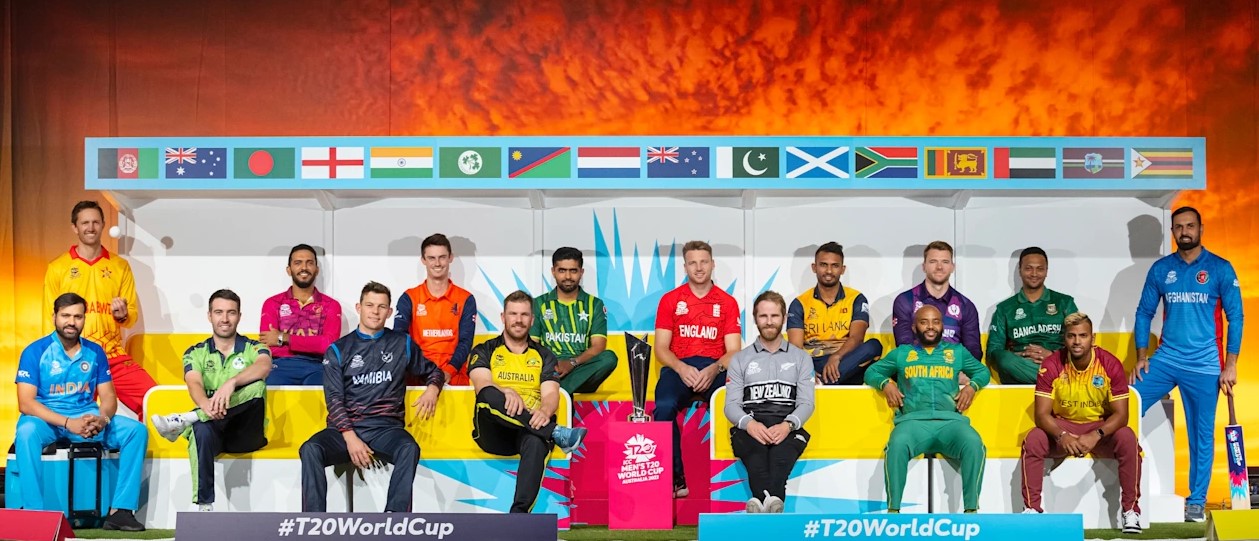
The International Cricket Council (ICC) is considering expanding the men’s T20 World Cup to 24 teams from the 2032 edition, according to a report by The Telegraph’s Tim Wigmore. The move is reportedly part of the governing body’s long-term vision of centring T20s as the global growth format, with an eye towards eventually establishing a 32-team global event in the future.
One step forward, two steps back
Coming on the back of controversial format changes implemented for the 2027 ODI World Cup, which generated widespread condemnation within Associate cricket circles, this is welcome news. However, it is scant consolation for Associate nations who harbour strong ambitions of playing the longer 50-over format, but have basically been frozen out of the ODI World Cup.
In reality, the ODI tournament has been scaled back to a 12-team event, with the bottom two sides from the “Super Series” round (those finishing 13th and 14th overall) effectively eliminated before the main competition truly begins. Their participation is in name only, relegated to playing in a glorified “Qualifier” and going home without an opportunity at taking on the big dogs.
It raises the obvious question about why the move towards inclusivity in the T20 World Cup has to be negated with elitism and exclusivity in the ODI World Cup format, all at the behest of the Indian broadcasters.
T20 World Cup format shakeup
While the overhaul of the ODI World Cup took up a lot of the media oxygen, the 2028 T20 World Cup underwent its own format tweaks. Now featuring five groups of four teams (as opposed to four groups of five) and a two-group Super 10 stage with knockout games to follow, the changes were made to “enhance competitiveness” and provide greater opportunities for Associate nations to qualify for the second round.
This could ultimately turn out to be more consequential than it first appears, not only for the 2028 edition itself, but what it portends for the future. An expanded 24-team World Cup from 2032 would naturally lend itself to the same blueprint, with six groups of four, followed by a Super 12 stage and knockout games.
A 32-Team T20 World Cup Format
But beyond that, with a classic FIFA style 32-team World Cup on the distant horizon, what form could such a tournament take?
Logically, it would make perfect sense to have the 32 teams split by eight groups of four. This will be identical to the group structure adopted for seven successive FIFA World Cups from 1998 to 2022.
However, with cricket’s penchant for super stages over straight knockouts and the commercial realities of the sport, it is unlikely that the group stage would be followed by knockout Round of 16 games. Instead, we are likely to see the top two finishers in each group progress to the ‘Super 16’ second round. Here, the sixteen qualified teams will be split into four groups of four teams each, with zero carry forward points from the previous round.
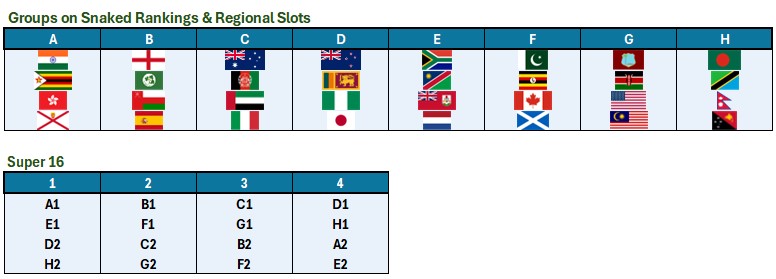
In the Super 16 stage, the teams again play three round-robin games each to determine the final standings in each of the four groups. The top two finishers from groups 1 to 4 then qualify for the quarter-finals followed by semi-finals and a final.
Overall, this competition structure will result in a sum total of 79 matches, which is 24 more than the upcoming 2028 edition. While this may appear substantial, it would dramatically expand opportunities for emerging nations to showcase their skills on the biggest stage. For a global sport seeking broader relevance, this is absolutely a worthwhile trade-off.
New and Emerging Markets
Expanding the tournament itself, however, is only half the equation. The global qualifier model needs to be ditched again in favour of direct regional qualification, to ensure decent representation of all cricketing regions. Teams making the Super 12 stage in a 24-team T20 World Cup could receive direct qualification spots, with the other 20 qualification spots awarded as follows: Africa – 5, Americas – 3, Asia – 5, East Asia Pacific – 2 and Europe – 5.
While cricket has doggedly preserved an exclusive members’ club over the last century, a 32-team World Cup represents an unparalleled opportunity to aim for genuine growth globally. It will do wonders to shed the sport’s ‘elitist’ tag. With Olympic status set to introduce the game to millions of new viewers worldwide, this is a golden moment to embrace expansion rather than continue gatekeeping the sport.
Countries that make up the next rung of Associate members around the world such as Spain, Germany, Nigeria, Japan, Tanzania and Malaysia, could become part of cricket’s new inclusive future, instead of continuing to be sideline spectators.

You’re reading Emerging Cricket — brought to you by a passionate group of volunteers with a vision for cricket to be a truly global sport, and a mission to inspire passion to grow the game.
Be sure to check out our homepage for all the latest news, please subscribe for regular updates, and follow EC on X, Facebook, LinkedIn and YouTube.
Don’t know where to start? Check out our features list, country profiles, and subscribe to our podcast. Support us from US$2 a month — and get exclusive benefits, by becoming an EC Patron.